


In the latest episode of the Blockchain Gaming World podcast, editor-in-chief Jon Jordan talks to Pixels CEO Luke Barwikowski about building its new web2 and web3 rewards app Stacked.
BlockchainGamer.biz: So what’s Stacked?
Luke Barwikowski: Stacked is the culmination of everything we’ve been working on at Pixels for the last four years, baked into one product. As we’ve been building out Pixels, we’ve been one of the only teams actually doing token live ops, trying to figure out how to make a web3 game work. Now we have some opinions on how to properly implement web3 in games. A lot of what we’ve been experimenting with is where to put the web3 inside of the stack and what it does in each stage.
A lot of people know Pixels for being play-to-earn. We actually had everything in the game onchain at one point. When you start to add onchain elements into a game, the end result is that your game economy becomes onchain and a form of real-money gaming, whether you like it or not. If you have a web3 game, whether you like it or not, you’ve made your game play-to-earn.
I view it that you can go a few different directions in play-to-earn. You can go risk-to-earn. You can go straight up real-money gaming, gambling. But that’s not what we want to do. What we are trying to build out is this concept of reward-to-play. Basically, it’s a new system where users get rewarded with rewards that they can trade. And the game company does so in a way that doesn’t break the bank and is actually profitable. It’s the Holy Grail, right?
In order to do that, we’ve started in a few different spots. Firstly, we started giving out rewards in Pixels. The biggest problem we ran into was bots and sybil attacks. That is the first step with any rewarded play system. You need anti-fraud capabilities. But that wasn’t enough, so we started approaching the problem in the opposite direction. We started doing more data-driven rewards.
This was a lot of segmentation, a lot of reward attribution inside our own tech stack. What we realized was that this is a huge problem set. It’s more difficult to build than Pixels as a game. Because we want to support play-to-earn in our games moving forward, we needed a centralized solution to manage rewards.
Essentially, we stripped a lot of the play-to-earn tech we had in Pixels, and we made a new product called Stacked.
It’s interesting that you say don’t start off putting all your rewards onchain.
There’s a naive way to do it. The naive way is just put everything onchain and don’t think about it. That’s probably possible in some iteration, but it’s going to be the hardest possible path for a team to have success. My approach is to start with one asset class. Then you can expand as you’re confident in those first asset classes. For us right now, our focus is two assets. It’s the PIXEL token and the NFT land inside the Pixels game.
What Stacked does is it allows you to distribute the onchain assets you have in your game in a smart way. It has two sides. It has a player-facing side and a business-facing side.
On the player-facing side, we created Stacked, which is a centralized rewards app that all of our users playing Pixels or any other game in our Pixels ecosystem can go to. They can check it every day. We can give them push notifications to see if they have new rewards, and we can show them all of the rewards they have. We also have different off-ramps. Stacked is launching initially with crypto cash-out with our PIXEL token. We’re gonna be adding things like gift card cash-out and fiat cash-out as well in the next month or two.
The cool part is that on the business side, we have a couple of different parts. We have an SDK that’s more like a data SDK, and we have a client-side SDK, which games can integrate and have no interaction with the Stacked app.
So for our current Pixels players, they don’t have to download the Stacked app. They get the full experience in the Pixels game. Effectively, we create a silent account for them on the backend in case they want to sign into Stacked in future. Of course, if they want to access other rewards, cross-game rewards, or use different cash-out rails, then they’ll have to use the Stacked app. But if they don’t, the Pixels experience and the rewards stay exactly the same. The tech can even be white-labelled and used in other games in this manner.
On the business side, we created a brain for giving out play-to-earn rewards. There’s a lot going on in the backend. There’s a data SDK. It’s just one line of code that you add where you log user activity to Stacked. That gives us data on your players that’s combined with the anonymized data we’ve collected from the Pixels ecosystem. What we’re building is almost like an ad network where we already have millions of users from Pixels. So we have a good understanding of the types of players, how they spend, how they interact inside games, if they’re bots, if they’re sybil farms. We’re able to do prediction, segmentation, and give you fine-tune control over who you want to target for rewards and for what reason. It also comes with attribution of these rewards and reward testing too.
Essentially, what we’ve done over the last few years at Pixels, we’ve been building a ton of data science models. So anytime that data is logged into our system, we start to learn more about the user, we start to categorize them just like any ad tech would do. Then in the dashboard, we also provide fine-tuned control over what kind of rewards you want to give out, and how to target them properly.
More recently, we’ve added another layer on top of this. One of the biggest issues we found, even internally in our own team, is that it’s very hard to come up with rewards that you can actually implement. A game economist needs to have a very detailed knowledge of a game economy and the specific game that they’re designing for. It’s not easy to design rewards. So we’ve added an agent layer that can go through your game. It can run all these data models that we’ve been using internally, come up with results and reports telling you things like, ‘This is an underserved segment. This is a segment that’s not retaining as well. This is a segment that is missing some spend compared to other segments’. It can create new rewarded offers that help achieve the KPIs you want to achieve inside your game.
A good example is you can talk to this agent and say, ‘Hey, I want to fix my onboarding funnel. I’m noticing that players from day 1 to day 3 are not retaining so well. Where are the key drop-off moments happening right now? And can you help me create offers that would help these users retain?’ It’ll go through these data models, look at segments that are churning. It will look at different gameplay aspects that are lacking between different segments. And it’ll help create rewarded offers that will be targeting these specific users to help them retain these specific points in the game.
How does this fit into your work on Return on Reward Spend?
We’ve been talking about this metric Return on Reward Spend for a long time. It’s a really basic metric. We look at it on a monthly basis. How many rewards did we give out this month? How much revenue was there this month? And we’ve made play-to-earn in Pixels sustainable over the last three months.
For everyone else in the space, their Return on Reward Spend is quite bad right now. What I see with most games, their default Return on Reward Spend, even talking about the leading web3 games, it hovers at 0.1 to 0.5. It’s quite hard to crack 0.5, especially when you’re dealing with tokens as your reward budget. Some models are better. Risk-to-earn might be a 1.1 thanks to their rake, but their issue is scaling their user base. They run into real-money gaming UA problems where you’re paying a very high user acquisition cost.
In our model, our customer acquisition costs are still in the category of free-to-play games, so it’s quite low. We’ve been running paid ads on our new game Chubkins, which will be coming out in the next month or two. Games like Chubkins and Pixels monetize like F2P games, so microtransactions, boosts and upgrades. The LTV per user isn’t high. Maybe only a few dollars. So, in order to have a sustainable game, you need to keep your customer acquisition costs low.

What we’ve done in these games is build a sustainable model where our RoRS is three to one, so for every dollar of rewards we’re giving out, we’re getting $3 of revenue, or $2 of profit back. We’ve been able to do this with this very precise reward targeting. People still play as normal. You don’t have to spend inside Pixels or Chumpkins, but when we’re giving out rewards, we’re a lot smarter. They’re more intended for retention, for sharing the game, for increasing monetization on the backend.
Practically, this means either your rewards become more UA-oriented, retention-oriented to get players into the funnels, or re-engagement, loyalty, cash-back for whales, or incentivizing people to try different games that they might not have done before. But the cool thing is players, their experience is they’re playing a game that they would be playing regardless, because they like it and it’s fun. And now they’re actually earning inside of the game too. The earning track is not blocked behind a paywall. You can literally play the game for free and earn, even if you’re playing the game for free and there’s no spending. This is because we look at the effect of the reward.
And in this manner, what Stacked allows us to do is that now my game teams can just focus on building out game features, just focus on building a fun game. And our platform team can focus on the reward optimization, all the data science, and these two things can be separated, which is a really, really nice thing to have.
Decoupling game design and rewards sounds like a massive win?
Yes. The key problem with web3 gaming, the reason I think most of the games have failed is because building a fun game is not enough when you also have to think about incentive design. This is such an insanely hard problem. Expecting any team to come in and build good web3 game without having any help on this side of things, is a tough, tough thing to do.
Personally, I’ve been obsessed with this specific problem. We’ve dedicated resources towards this from the very start of Pixels. I know a lot of people see Pixels and see a cute, little farming game, but this was the core problem we’ve been trying to solve the entire time. Because we needed to get Pixels to work. The entire intention when we built Pixels at the beginning was to treat it like a testing ground to figure out how we can make play-to-earn work. And then make the game better as we do that.
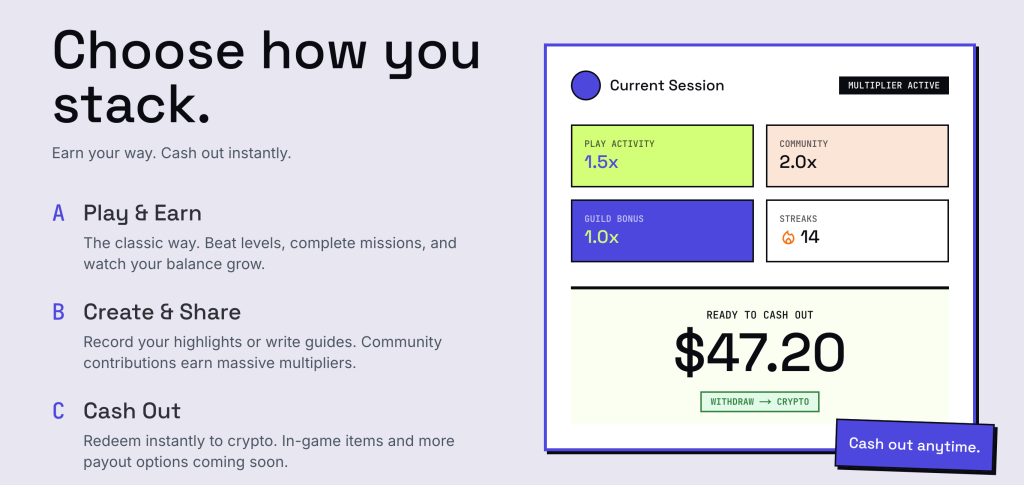
Now my team has the freedom to only focus on game features. If you’ve been following Pixels, the gameplay has been getting a lot better over the last year because we freed up that team to just focus on gameplay. Even with this new game we’ve been developing, we can have a team fully dedicated in Chubkins just making the game, and this reward layer comes on top. We don’t have to make sacrifices in Chubkins in the game loop in order to add the web3 layers on top.
More generally, what does this mean for Pixels and PIXEL?
We’re slowly going to transition the PIXEL token to become stake-only. The rewards will transition to USDC for the crypto audience, or Stacked points rewards, which will allow you to cash out to gift cards or PayPal for US dollars. You’ll also be able to turn it into crypto and do an instant cash-out. The instant cash-out is actually a very big feature of crypto.
What’s nice about this is that if a web3 company does have a token that they want to distribute, they can do it through the system. They don’t have to be publicly facing inside Stacked either. If they wanted to white-label this, tell nobody that they’re using it, they can go ahead. I don’t really care.
But there will be benefits to being public-facing when we start to get the Stacked ecosystem going in terms of cross-game UA and promotions. For example, we have good data on Pixels players, so we know who is very good and valuable to the ecosystem. We’ve labeled them. They’re great people to have inside your game. This would be a good opportunity to get cross-game offers. If you want to target people who have been spending in Pixels or spending inside any of the ecosystem games, you can go and run the campaign.
We also have a budgeting system inside Stacked that will help allocate these rewards smartly, and make sure you don’t go over budget, make sure that you’re only paying on conversion. These conversions should really only be profitable for a game. So this is a very, very powerful, useful tool.
When it comes to scaling other games, what’s funny is we have web3 support, but I don’t think there are that many web3 games ready to take something like this. If they do, I think they would start to see their economics improve. But what we’ve done is built a system that can turn any game into a play-to-earn game. We’re not going to be launching with a lot of web2 game partners in the beginning stages, but that’ll kind of be the next target as we look to prove out this tech, to show the world that we have this tech, which is really scaling Pixels and Chubkins and the other first-party games that we have. And then we’ll start to work with web2 partners.
Why is crypto important to Stacked? Why not just do it as a non-crypto rewards platform?
There are a few reasons why developers would still want crypto assets inside of their game. For example, trading items is way more convenient in web3 using a web3 marketplaces. Chubkins is not going to launch with web3 assets at the beginning, just like the earned currencies. But we’ll probably add items that you can trade.
A good example is Monopoly Go. Monopoly Go has stickers inside the game, and there are Facebook groups for trading those stickers. That is a very good asset class example for a mobile casual game that would be a lot better in web3 where sticker trading happens instantly. It’s trustless. You don’t have to go through Facebook groups. That’s the kind of asset we might add in addition to a token or an earned currency.
Then, when it comes to PIXEL, and why somebody would want to hold it, for us, it’s a solid value-add because there’s an ecosystem behind this. There’s revenue flow behind it. There are blockchain enthusiasts who want to be a part of this. There’s this play-to-earn protocol.
The truth is the average player doesn’t care so much about it. But there are players who really do care about decentralization, the protocol, and all of that. And what’s great is if they want to take PIXEL as a reward and participate in the onchain components of staking and the protocol, and maybe governance eventually, that will be available to those enthusiasts.
Find out more at the Stacked website.
Comments are closed.