


Originally launched in 2003, the MapleStory franchise has generated more than $4 billion from its over 250 million players. But publisher Nexon is always looking to future technologies to ensure that its key IP remains relevant and successful.
That was the reason it backed its web3 division Nexpace with a $100 million investment in 2023, empowering it to use blockchain to make a MapleStory game that could continue the franchise’s growth in the coming years.
Running on its own Avalanche-based Henesys chain, MapleStory N launched in May 2025, attracting 3.8 million accounts and 850,000 engaged wallets, and generating $31 million in revenue, making it one of the most successful blockchain games.
But that’s not the goal, according to Nexpace COO Keith Kim.
While the first year was all about launching and sustaining a game, the future is about allowing users to build their own games and utilities using MapleStory’s onchain assets; something which is highlighted as MapleStory Universe.
We caught up with Kim to find out more about how the first year had gone and why he’s so enthusiastic about the future.
How do you think the first year of MapleStory N has gone?
Keith Kim: I grew up playing MapleStory. I know every corner and almost every aspect of MapleStory, even before I started working on the blockchain version of the IP. Ever since launch on May 15th 2025, it has been exciting and also quite crazy. When we launched, a lot of gamers came in to play, but the player profile was quite different from what we used to know from the web2 version.
We spent at least three or four months trying to learn what the landscape was like, what our players were like, and how they were different from the players we used to know in web2. We made mistakes, fixed them and iterated repeatedly.
If I were rating how we performed over the last year, I wouldn’t give ourselves an A+. There are areas where we could have done better, and things I wish I’d known before we experienced them. But what we did well was that the whole team, more than 100 people working on the project, was very agile in learning and altering our strategy to fit the new player profiles. We adjusted quickly to the market and tried different strategies.
Over the last year, the pace of updates was at least three to five times faster than what we used to do in web2. It was content after content update, events and collaborations one after another. It felt like a fast-paced F1 race inside MapleStory. It was very exciting.
In the second half of last year, we were learning, adjusting, changing strategy, testing and doing A/B testing. From February onwards, especially after one of our biggest updates with new content, new maps and new boss monsters, we started to see really good numbers.
What have been the particular challenges of running a blockchain game?
One of the biggest problems for blockchain games that emit a token is sustainability. Often they emit value of 100 but only recoup 80. That negative 20 accumulates over time and eventually dries out the gamers, the interest and the money. That was a very important challenge for us.
From February onwards, we started to see positive numbers. We might give out 100 tokens but recoup 120 or 140. We thought that was fantastic. That was when we started to understand how we should drive the game forward operationally.
Since then, we have continued to see positive accumulation around the token. This month is likely to be the biggest accumulation ever. Since the first anniversary on May 15th, we have launched a lot of updates, campaigns, maps and in-game classes. Fortunately, the players seem to like them.
I hope this month ends as the highest revenue month since launch and also the biggest deflationary month for the NXPC token.
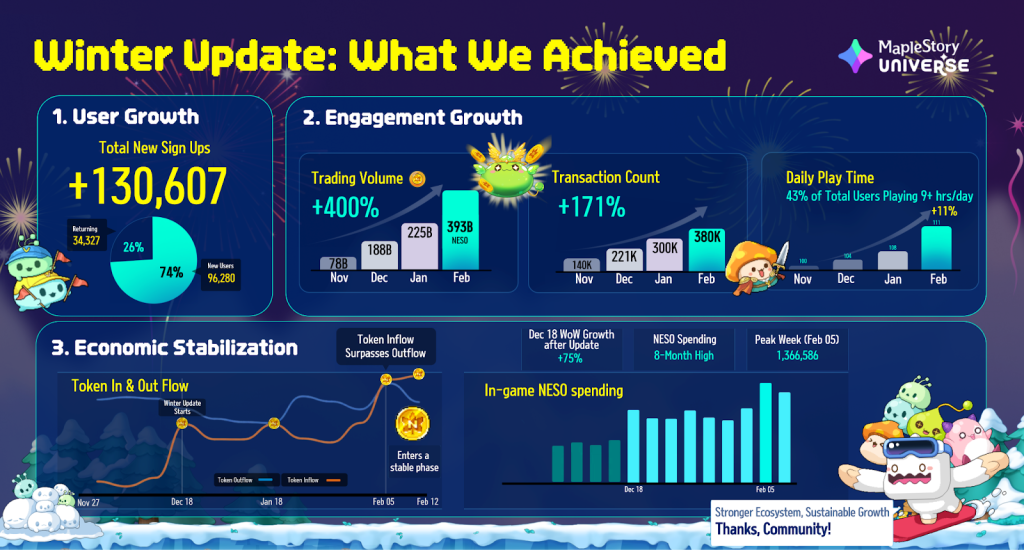
A lot of games are struggling with sustainability. We have seen many blockchain games close down over the last 12 months, which is sad to see. If you have a token, all the marketing, compliance and operational hurdles become five times higher. That was one of our biggest challenges and one of the biggest concerns in my head.
But over the last 12 months, and particularly over the last six months, we have been steadily going back up across different numbers: players, revenue, token price and other metrics. I think our second year, across 2026 and 2027, will be more exciting.
What’s the difference between MapleStory N’s audience and that for a web2 game?
There are always gamers who play for financial incentives, even in web2. Wherever there is demand from players willing to pay for entertainment, there are people willing to supply and make money from it. But there was definitely a big difference in proportions.
In web2, maybe 60%, 70% or even 80% of players are playing for fun and entertainment. Maybe 10% are playing purely for money, and another 20% enjoy the game while sometimes making money. There is a wide spectrum of player profiles.
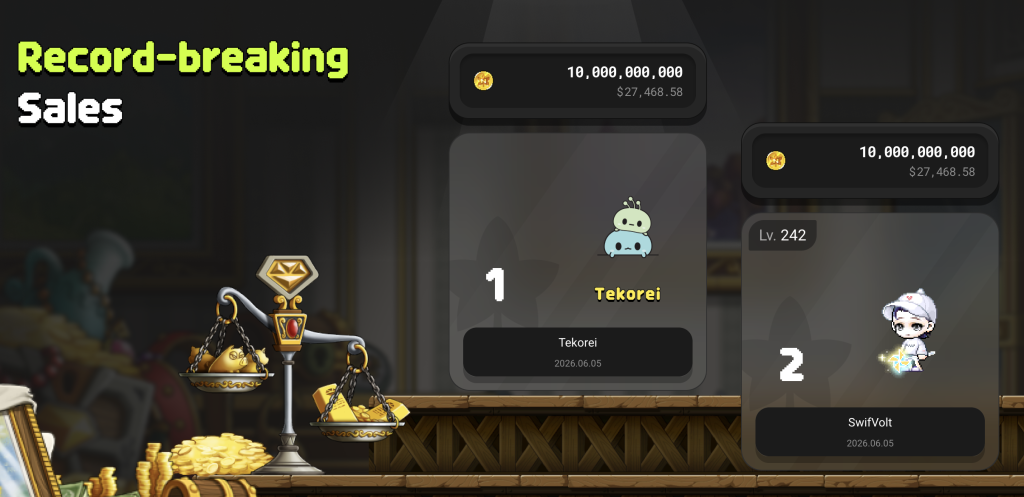
In the web3 version of MapleStory, what we saw was a bipolar distribution. Some players were spending incredible amounts of money in the game, much more than the web2 average. They were spending literally $100,000, or £60,000, per day. I had never seen that kind of population before.
At the same time, we saw players spending an incredible amount of time trying to make money. In the early phase after launch, more than half of our players were there purely to make money.
Historically, over the last four or five years, a lot of blockchain games have followed a pattern: if you want to make money, you jump in fast, accumulate the required resources and assets, make quick money over one to three months, sell everything and leave. We saw a lot of that behavior in our first three months.
A lot of people thought: MapleStory is a big IP, so maybe this will last another three months. Let’s make the most of it and then leave. The first three months were pure chaos when we looked at the numbers. There was so much noise in the data: concurrent users, newly registered users, average spending by different profiles, time spent and so on. It was nothing like Web2.
We were seeing 150,000 wallets signing up in a day. In web2, if we saw 150,000 new users, the other numbers would change accordingly, but we weren’t seeing that. We spent a lot of energy trying to make sense of it. A lot of people were there to farm and make money. Some people just wanted to make $5 or $10 a day. We had hundreds of thousands of them. Others were spending $10,000 trying to make $50,000 or $100,000 after three months.
That felt like the general expectation around MapleStory N, and I strongly disagreed with it. As a big MapleStory fan, I didn’t want MapleStory to be something like that.
How did you try to change that sort of behavior?
Although I have been head of strategy and COO for the last year and a half, I was also deeply involved in the tokenomics and in-game design because I was one of the biggest MapleStory fans within the team. We had a team of MapleStory fanboys asking: how can we enhance the gameplay experience? How can we make it more fun with blockchain technology than without it?
It was difficult to see that these ideas, which were intended to enhance the fun, were not really appreciated by the majority of users in the first three months.
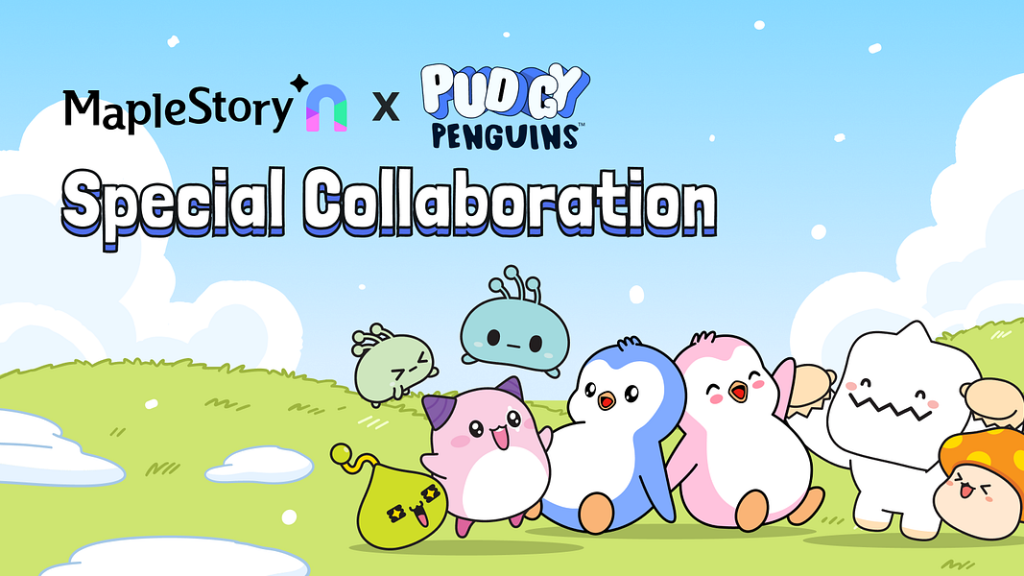
Eventually, we tried different strategies. We sped things up. We tried to make users dizzy with the fast cadence of content. We did collaborations with web3-native brands such as Pudgy Penguins. We tried to learn how different users reacted and whether we were seeing a shift in user distribution or user profiles.
Only after about six months, when the hype and foam washed away, did we see the real fans of MapleStory. They were actually having more fun with the blockchain version of MapleStory than the version without it. That moment, around last December and January, was when I regained confidence. Maybe we were doing it right. Maybe we were slow, and maybe the market did not yet have many gamers seeking entertainment, but we were going in the right direction.
I myself was enjoying the game. Many MapleStory fanboys inside our team were enjoying it too. If we keep doing this for another few years, we can be noticeably better than the web2 version, using blockchain technology.
You’re now allowing players to build MapleStory games using AI. How did that come about?
Last December and January were eye-opening moments for AI. Before that, AI could help me write emails, proofread and expand short text. Those things were helpful, but they didn’t feel life-changing. Then, suddenly it felt like my occupation could change. I could now be a developer.
It felt like having a camera in your hand for the first time because smartphones had been invented. Suddenly you could take high-quality videos of your life, not just photos, share them and even make money from them. It was that kind of moment for me and for many people on our team.
There are about 130 people on our team, but only around 30 are game developers. The others are business people, strategy people, marketing people, blockchain developers and so on. Quite a lot of them had never built a game before. We encouraged first-time game developers inside the team to build their own games.
I was very surprised to find myself playing some of these games for hours. I consider myself narrow-minded in terms of the game genres I prefer. I mostly play first-person shooters, MMORPGs, League of Legends and a few others. I don’t play a wide variety of genres. One of the games was a deck-building game, similar to Slay the Spire. I never thought I would spend hours playing that kind of game, especially one built by someone who had never built a game before. I was totally mind-blown.
That was when we started having a lot of discussions with our CEO, strategy team and business team, trying to imagine how the world will change. Imagine the world before YouTube or before social networks. Before we experienced those things first-hand, it was hard to imagine them. We are always confined by what we have already experienced.
The range of possibilities is very wide, but we tried to imagine the most likely scenarios for how the future will change, especially in the games industry.
Our biggest strengths are two things. We have IP that people love, and we have people who love that IP. We have the network effect and users who love being there. The question was: will this IP still be useful in the future?
My first thought was no. Maybe IP will be dead. Traditionally, IP has power because it has shared networks and shared memory. If you play MapleStory, you understand how good I am just by me telling you my level is 150. You know I have been grinding. That recognition and network effect are core driving factors behind an IP.
But in the future, people may no longer need that kind of recognition. AI may just build something perfect for you, which nobody else plays because it is tailored only for you. Then people may see less importance in IP.
That was a big concern. What should Nexon do? We have MapleStory and Dungeon & Fighter. In 10 or 20 years, maybe nobody will demand these kinds of IP anymore. That is a big issue for us.
So you’re allowing gamers to use AI with your IP to stop AI cannibalizing your IP?
Yes. We explored different ways that IP could expand. But it always came back to this: we cannot do it alone. We are a team of about 100 people building one IP and maybe an ecosystem.
To fight the invasion of AI, if you cannot beat it, join it. Let AI be on your team. Let all the fans, maybe 250 million MapleStory fans around the world, build for you and for each other. We will be the IP holder.
That is why I have been saying that this year and next year, I want to see builders make more money than we do out of MapleStory. That is pretty much the only way forward.
Our focus [at Nexpace] is still on MapleStory. We are not letting it go. We are spending a lot of time making sure the core experience and content get better and keep being updated. But the other half of our energy goes into making it easier to build on MapleStory and easier to make money on MapleStory, so builders have an incentive to do it.
One of the biggest challenges is how we can make someone who has never considered themselves a developer or game developer think otherwise. How do we make them think: maybe I can be one? That first baby step is very difficult. It is like crossing a chasm. That is one of the main challenges we are thinking about now.
It’s refreshing that a game company is being so positive about using AI.
There is a split among IP holders. Some IP holders cherish their IP so much that they would not let anyone draw something on their baby’s face. They want to keep it exactly the way they want it.
The other side is more like us. Of course, it was not an easy decision. There were a lot of discussions and persuasion: is this really right? Are you sure? There will still be censorship. I definitely do not want pornography. But there will not be censorship around what is fun or not fun.
AI slop exists. We are building a lot of tools to make sure less slop appears when people use AI, because most people building games with AI are first-time builders, so lower quality is inevitable. But we are building tools to help prevent that, and I think it is only a matter of time before the output becomes pretty decent.
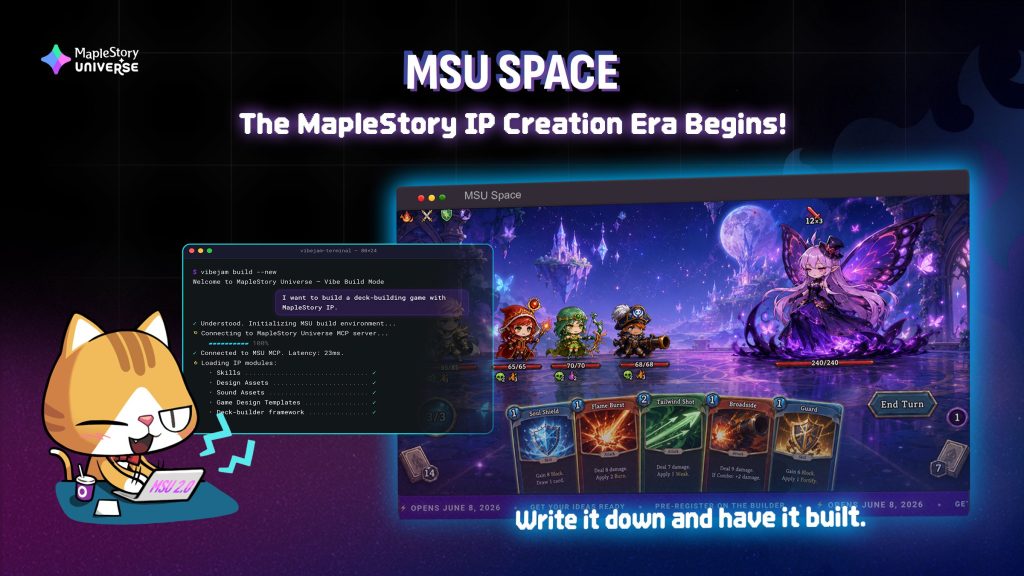
The hardest part is that game makers tend to judge what is fun and what is not. I think that is a big mistake.
Look at YouTube or TikTok. If you have worked for the BBC or a big broadcasting company, you may have a £100,000 camera and a crew going around in a truck with all the equipment to make a superb-quality video. Then someone in Southeast Asia records something on a mobile phone, edits it on the phone, uploads it to TikTok and gets 500 million views.
That is what people like. How can you say what is good and what is not, or what is high quality and what is not? It is up to users to decide. What gets picked is good quality. What does not get picked, even if it has superb graphics and production value, is no longer necessarily good.
My CEO had to convince me of this concept. I kept saying the game has to be like this, the graphics have to be like this, and the physical mechanics of jumping around in MapleStory have to be faithful to the original version. I had difficulty letting go of those concepts. But now I get it. Minecraft and Roblox are not GTA. They do not have the most realistic graphics or physics. It is simply about what users pick.
For that kind of moment to happen, we need a lot of content. That increases the chance that something gets picked. This is a great time for that to happen because you have IP and you have fans. They can all become builders and creators, and they already know the IP so well. They remember what they liked about MapleStory and what they did 15 years ago that they would love to see again.
Now they have the tools and the means to build it and commercialize it. I think we will see a major paradigm change very soon. It is a very exciting time.
And as well as individuals, companies can also get involved and make money.
We are pursuing two different tracks. One track is actively reaching out to professional studios, maybe teams of 30 to 100 people, that are interested in using the MapleStory IP.
Last year in South Korea, a non-Nexon company called Able Games licensed the MapleStory IP from Nexon and built its own idle game [MapleStory: Idle RPG]. It made over $150 million in six months. That is big revenue.
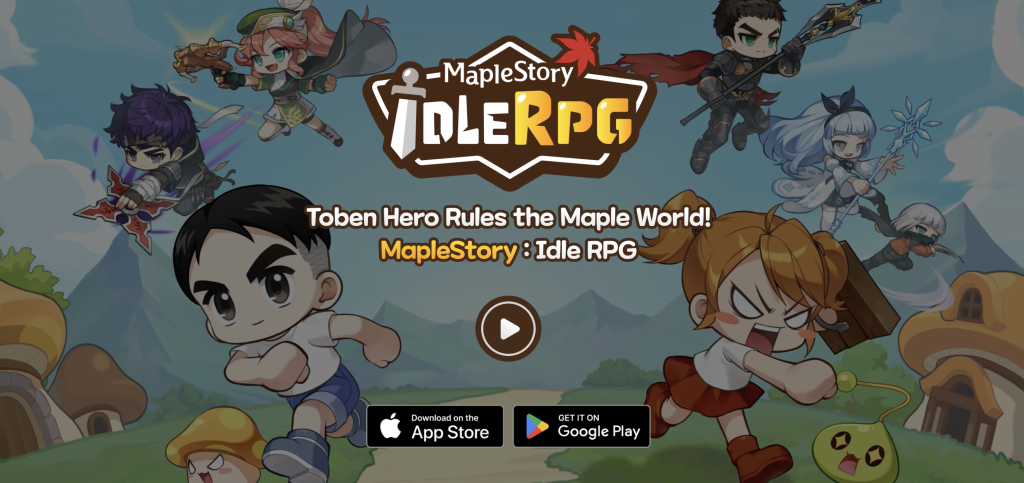
MapleStory IP can be very meaningful when the timing is right and when a company has expertise in a specific genre. Building an idle game also takes expertise: how you attract people interested in that genre and how you operate it. So those collaborations are very meaningful, and we are actively seeking that route.
At the same time, imagine building YouTube for the first time. You might reach out to the BBC or National Geographic and ask them to supply professional videos so people have something to watch. You need that professional content, not just casual selfie-style content.
But we are also encouraging individual builders. We are not expecting them individually to make a million dollars anytime soon. But imagine making $300 or $400 from your YouTube channel, or making a few games a month and earning $100 to $500 per month.
Once you have released 30, 50 or 100 games over time, maybe one of those games becomes huge and maybe you become a millionaire. That kind of thing happens. We want to open the door wide. It is a blue ocean business. There are not many people doing this well or doing it right.
The key is encouraging a population who never thought they were creators but now can be. You can share a video on Google Drive, but people don’t do that because it is much better to do it on TikTok or YouTube. We are trying to build the first platform where it makes sense to be if you are going to build a game.
Find out more at the MapleStory Universe website.
Comments are closed.