

This month, we asked our Mavens:
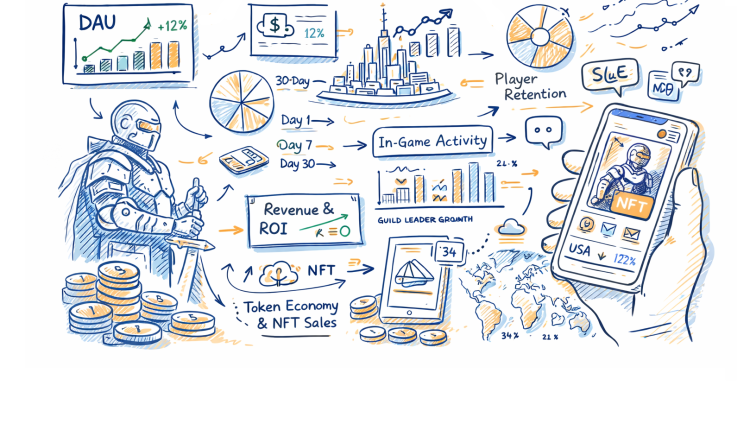
What are the key metrics to building a sustainable web3 game in 2026?
Sunyoung Hwang, CEO, NEXPACE

Sustainability in web3 gaming in 2026 ultimately comes down to three key principles that are straightforward in theory, but difficult in practice.
The first principle is making blockchain invisible. At MapleStory Universe, we serve a player base spanning crypto-native users and millions of long-time fans of the original MapleStory IP. For many players, wallets, gas fees, and tokenomics are barriers, not bonuses. The blockchain layer should be doing meaningful work, enabling true asset ownership, powering open economies, and mitigating harmful activity behind the scenes, allowing the player to focus solely on the game itself. If infrastructure navigation bleeds into the gameplay experience, the design has already failed.
The second is fostering a loyal player base. Sustainable games can’t rely on airdrops and TGE momentum alone. They need players who keep coming back because the gameplay loops are genuinely compelling and exciting. We see this in our recent Winter Update, which revealed a significant wave of user inflows, both new and returning, and a spike in highly engaged players. Critically, that engagement is now reflected in how tokens move through the ecosystem. Following the Winter Update, MapleStory Universe recorded net monthly deflations: in other words, more NXPC was consumed within the ecosystem than flowed out of it. When players engage because they love the game rather than purely to extract value, the economy stabilizes naturally.
The third is treating your economy as a living, breathing ecosystem. Tokenomics require active stewardship: continuous monitoring of economic and player health, watching for inflationary pressure and extractive behavior, and responding before problems snowball.
After almost a year of live operation, we have realized that the size of rewards participants earn matters far less than how sustainably those rewards are distributed. An economy that prioritizes extraction erodes the very foundation it depends on. That insight drives our approach: we are actively restructuring multiple systems within MSU to ensure value circulation rewards genuine participation over time, rather than concentrating on early extraction windows.
Market volatility and trend shifts are inevitable hurdles in the web3 gaming landscape. What separates successful projects from cautionary tales is steadfast commitment to a long-term roadmap with a consistent conceptual vision and economic ecosystem. For us, that commitment is reflected in the decisions we make, update after update, to optimize the ecosystem for the players who choose to stay.
Hilmar Veigar Pétursson, CEO, CCP Games

Building a sustainable web3 game in 2026 requires moving past a product mindset to embrace a protocol reality. Having steered the EVE Online economy for over two decades, I have seen that true longevity is an emergent property of player agency. Sustainability occurs when a single-shard universe allows player actions to create genuine value and systemic velocity.
With EVE Frontier, we are removing the publisher-controlled centralized ceiling by enabling modding at scale and allowing builders to deploy at the protocol level. Shifting from a private database to a transparent ledger means players can own assets and codify their own laws, industries, and trustless businesses – permissionlessly. This ensures the world is engineered to outlive its creators and remain functional for a century. Or more, I hope.
The democratization of development is accelerating this evolution. Through LLM-assisted development and AI agents, the barrier between having a vision and executing it has vanished. Everyday players now use these tools to build sophisticated Smart Assemblies and autonomous economic engines that previously required a full development team. When players monetize their ingenuity directly and build persistent enterprises onchain, our virtual world becomes a sovereign career rather than an entertainment expense.
For us, the question is not how to build a sustainable game in 2026. We are building the infrastructure for 2126 by handing over the keys and letting the inhabitants become the permanent fabric of the universe itself.
Christina Macedo, CEO, PLAY Network

Retention, retention, retention. Strong retention metrics — especially at D1, D7, and D30 — have always been the clearest signal of a game’s trajectory: how long it will last, how effectively players will convert to paying users, and how much additional scale must come from organic growth versus paid acquisition.
In mobile games, widely accepted benchmarks put D1 retention around 35–45% (top performers 50%+), D7 at 15–25%, and D30 at 5–10%. Hitting or exceeding these ranges has historically indicated a product with the potential to scale into a sustainable business.
That hasn’t changed across console cycles, mobile booms, or live-service eras, and it won’t change now. What has changed is who (or what) is on the other side of the screen. Increasingly, some of the “players” interacting with your systems are AI agents operating within or alongside human users. As these agentic participants enter game ecosystems, familiar behavior curves, engagement, retention, monetization, will begin to shift.
The next 100 million participants in your game may not all be human. If a meaningful share are autonomous or semi-autonomous agents, the core design question evolves: what does it mean to retain an agentic player? Which KPIs matter when the user can optimize itself, operate continuously, or act on behalf of someone else? Traditional friction points, time scarcity, skill ceilings, content exhaustion, may simply not apply.
These are not theoretical questions. They will determine how virtual economies balance, how progression systems are tuned, and how monetization models adapt. Studying, benchmarking, and redefining retention for this new demographic will be essential to converting agentic participants into economic value, whether through direct spend, delegated spend, or ecosystem activity.
The studios that solve this earliest won’t just attract more users, they’ll build sustainable economies designed for a hybrid population of humans and agents alike.
Robby Yung, CEO, Animoca Brands

I think this is a really good question and definitely something that everybody in the web3 game ecosystem has been grappling with for the last several years. I think the main metric to always be mindful of is the most traditional one, which is really just taking a look at your P&L and asking yourself if you’re building a profitable and sustainable business. The follow-on question is, what are the metrics that drive that P&L and create that sustainability?
For that, I look toward some of the most traditional metrics, namely retention. What is your stickiness, and how do you measure how you’re serving your most passionate fans, and how big is that audience? As we’ve seen in web3, our ownership-led games tend to lend themselves to engaging smaller groups of very passionate fans. These fans, because they’re so passionate, also tend to be higher spending and have higher retention rates. So once you’ve engaged them, then the question is how you build on top of those audiences and broaden the appeal. I think this is where many web3 games have struggled to break out across multiple market cycles to engage those audiences outside their natural core fan base.
All that having been said, I think the key to sustainability in 2026 is ultimately going to be this seismic transition to AI-driven or AI-assisted development practices, which will change the economic model of the cost of producing great game content.
Sam Barberie, head of strategy and partnerships, Sequence

The metrics defining success for a web3 game shouldn’t differ from any other game: MAU x conversion rate x ARPPU = gross revenue — ROAS = net revenue. Add on D1-D30+ retention. If any of these KPIs don’t align, underperform the market, or swing in the wrong direction, potential for sustainability is dire without major design or targeting changes.
During nearly a decade of building SuperData Research through our Nielsen acquisition, we consistently saw themes and predictors that demonstrated when games’ futures were dim. Some short-term strategies would make metrics look good (like explosive MAU) at the cost of other metrics (like high UA costs), especially as other metrics soured (like decreases in conversion and ARPPU due to acquiring low-value users). In these scenarios, developer teams that didn’t have a holistic understanding of their metrics or didn’t see the warning signs were often too late to save the game later.
Most web3 games haven’t achieved significant numbers for any of the the underlying health metrics, especially in a post-IDO and post-founders pass world. The days of a micro-network of investors (not players) driving big commercial outcomes are over. Most web3-integrated games should have profiles that look very similar to those in F2P games, with potential for blockchain-native or -improved differences:
- 1. Secondary revenue—games with a secondary marketplace should look at this for incremental revenue potential (but not at the expense of primary sales). I’ve written extensively about how secondary markets can: a) convert non-spenders, b) increase spending power in the primary market, and c) improve retention. This already happens with games like CSGO.
- 2. Reduced overhead and fees—Smart devs are eyeing stablecoin payments, whether for on-chain assets or not. Lower fees, instant settlement, easier UGC payouts, etc. This is a no-brainer across the board.
- 3. Possibly improved user targeting/reduced CAC—In the future, it should be much easier to pinpoint a whale using wallet data rather than leaving UA to the algorithm gods.
- 4. Improved retention—We do already have evidence that web3-enabled games can see better retention than web2 equivalents.
These possibilities don’t change what’s core to a game’s sustainability and performance, but their benefits to revenue, UA, opex, and retention show how developers should focus on greater optimization. Ultimately, web3 technology is only as good as its ability to enhance KPIs. Developers must start from the same baseline as all other games and then eye the improvements that the blockchain unlocks.
Gabby Dizon, co-founder, Yield Guild Games

Revenue. The industry has spent too long measuring the wrong things, using outdated metrics like VC funding, token price, and NFT sales. For us, it was important to identify the users who are actually willing to spend money on games, and then understand what kind of games they’d want to pay for.
That’s how we learned that the most valuable segment of the market right now is the “Casual Degen,” the crypto natives who love watching the charts and trading perps and are looking for fun, lightweight onchain experiences. These users already have funds in their wallets and would be happy to make in-game purchases to progress and gain an edge over other players.
In our experience with LOL Land, we saw its ARPPAU peak at $4,263 in October 2025, which is not bad for a game that’s less than a year old.
Sustainability happens when you focus on your spenders rather than chasing TVL or airdrop hunters. I would rather have $4,000 spent in my game than $400,000 in TVL. A sustainable model requires a real digital economy where people are willing to pay because they see value in the assets or the gameplay.
Check out our other recent Mavens questions below:
- Have AI agents changed your 2026 game plan?
- How can blockchain games balance fun and finance?
- What’s been the most prominent shift in web3 gaming in 2025?
- Is the degen market now big enough to sustain profitable blockchain games?
- Do web2 games with separate web3 versions make sense?
- What can we learn from withered web3 games and those that are thriving?
Comments are closed.