

At 6pm on 13th October, Yield Fields opened the public phase of its Founding Deeds sale. This was a so-called fair Dutch auction, designed to run for 24 hours with the price sliding from 1 ETH down to a minimum of 0.069 ETH. But all 3,333 deeds went almost immediately, settling at a final price of 0.999688 ETH.
“What the f* just happened,” founder Skarly posted shortly afterwards.
If every deed settled at that price, the mint grossed around 3,332 ETH, or about $8.3 million. However, that figure comes with one caveat. Before the public auction, there was a guaranteed allocation for whitelisted wallets, and it isn’t yet clear whether they paid the same final price. Either way, an onchain farming game has raised several million dollars without any VC money, on a blockchain that’s barely out of the box.
For the blockchain, Robinhood Chain, is the other part of the story. The brokerage’s EVM Layer 2 has quickly picked up a cluster of small games: idle cat businesses, pixel farming games, floating-island hashrate simulators. Most of them look like the usual tokenized busywork. Yield Fields is the first to show that real money is prepared to turn up.
That isn’t all down to the chain. Skarly also founded Onchain Heroes, whose roguelike dungeon crawler Maze of Gains acted as the funnel. During September’s Deed Season, Maze of Gains players competed for 850 whitelist spots, 575 through an in-game Silo of Gains and 275 by raffle. Players had spent more than $3 million in Maze of Gains before Yield Fields had launched anything. In effect, one game’s players pre-funded the next game’s land sale.
The game’s design also tries to avoid the classic land-sale trap. Anyone will be able to farm in Yield Fields without owning a deed. But deeds give holders land to build on and a separate resource loop. The first example is Fertilizer, made through Fert Decks, which ordinary farmers will need. The pitch is that deed holders are producers in an economy rather than gatekeepers to it. Whether that holds up depends on how many farmers without deeds actually turn up and keep playing.
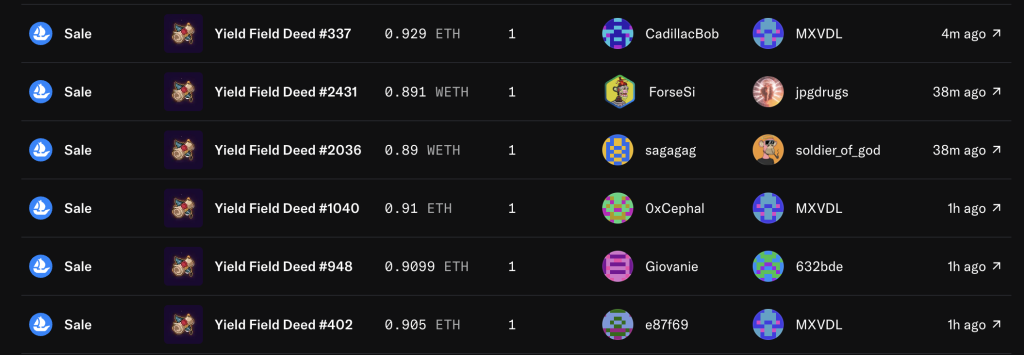
Deeds became tradeable on OpenSea straight after the mint. In the first 16 or so hours, the collection recorded 464 sales and 439 ETH in volume, around $1.1 million. That’s roughly 14% of supply changing hands in a day. The floor sat between 0.905 ETH and 0.94 ETH, 6% to 9% below the mint price, and sellers also pay a 5% creator fee so anyone who minted to flip has lost money. But the floor hasn’t collapsed either.
Ownership is reasonably spread. 1,440 wallets hold deeds, an average of 2.3 each, against a mint cap of five per wallet. One holder stands out. A wallet labeled Chunibro has 149 deeds, 4.5% of supply. They’re worth around 131 ETH (c.$250,000). The next largest holder has 54. The Yield Fields team wallet holds 20.
What happens next is mostly unannounced. Skarly has said the mint proceeds will be used “to kickstart our various flywheels and make sure that [redacted] is in good shape and thick from day 1.” Nothing official has been said about that, or about a launch date for the game itself.
So the questions for the coming weeks are straightforward. When does farming go live, and do players who didn’t buy deeds turn up? Does the Fertilizer economy create real demand for what deed holders produce? And if a token arrives, does the mint treasury support it, or does the token become the exit liquidity deed holders are waiting for?
But there’s a broader point too. VC money for web3 games has dried up, yet a single game sold more than $8 million of land in half a minute. Crypto gaming hasn’t stopped raising money. It’s now just raising it from players instead. Nature is healing.
Find out more at the Yield Farms website.
Comments are closed.